

NeurIPS 2026 Creative AI: Frictional Intelligence
Push for human agency, deliberation and literacy through tangible interfaces for LLMs
AUG 2025 - DEC 2026
Posheng Cheng. 2026. Frictional Intelligence. In The Fortieth Annual Conference on Neural Information Processing Systems Creative AI Track: Agency. https://openreview.net/forum?id=IRrg0HIyyR
learn more about the project at the portfolio page
Abstract
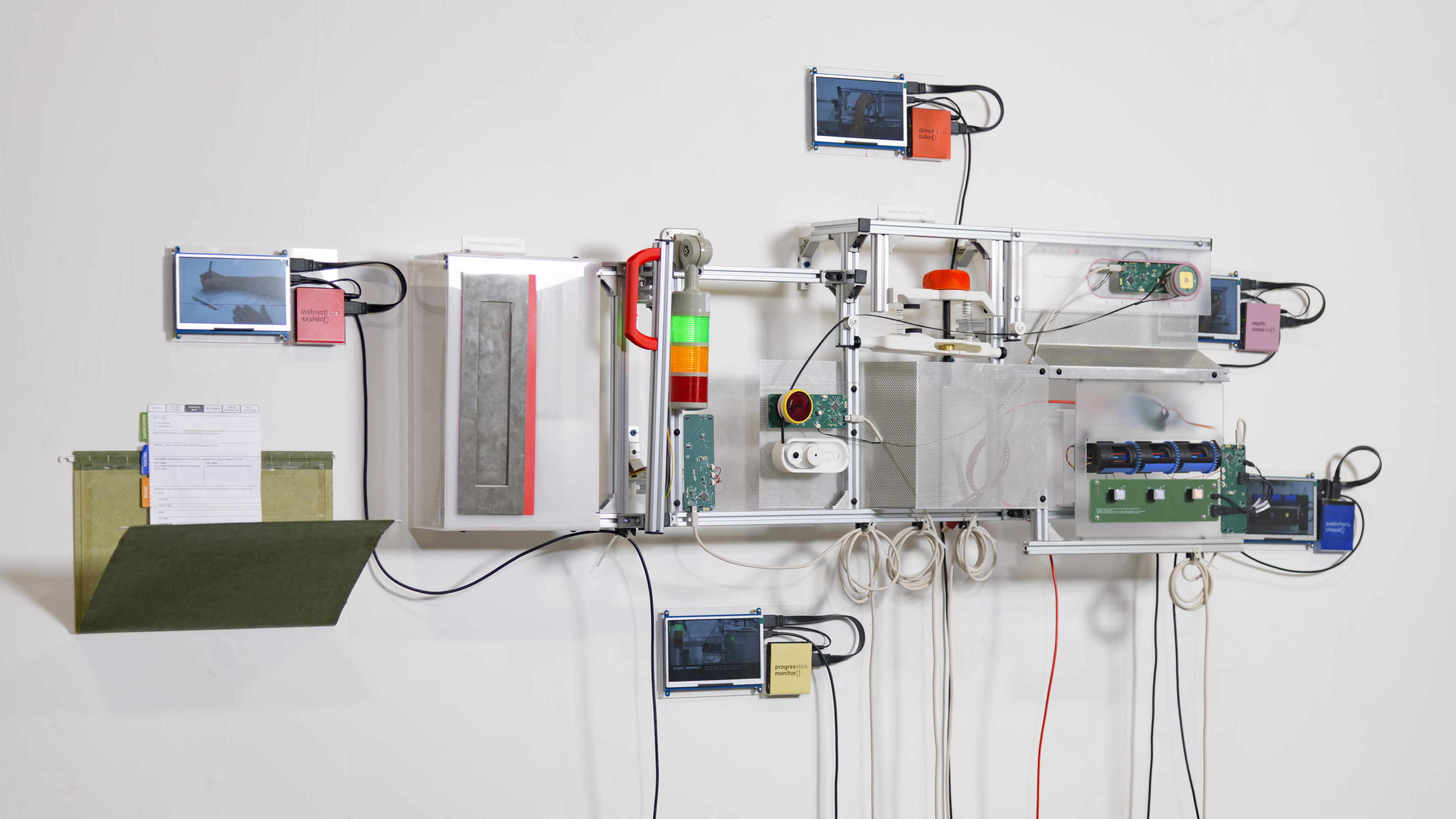
Frictional Intelligence is a speculative design installation that reimagines AI systems as human-made, human-owned tools, offering a polemic to the prevailing focus on human-like metaphors. The installation employs machine-like interfaces to emphasize human agency, deliberation, and technological literacy, while questioning the increasingly blurry distinction between human and machine.
Introduction
Imitating human behavior has long been a tradition in Human-Computer Interaction. With the emergence of transformer-based generative Large Language Models, the promise of a computer capable of conversing with natural languages is finally fulfilled. However, this new level of human-likeliness also clouds public perception of AI, indirectly leading to the resistance against the technology.
Prevailing chatbot or humanoid AI embodiments encourage cognitive surrender, imply machine moral status, and obscure the algorithm's probabilistic nature. These systems use authoritative language to appear overly believable, trustworthy and sometimes manipulative. Current AI interfaces are intentionally designed to diminish human agency, and Frictional Intelligence aims to imagine an alternative vision of AI that does the opposite --- empowering humans by giving them more agency over the machine.
Implications
Frictional Intelligence, with its machine-like interfaces, positions AI firmly as an intelligent machine tool that is built, used and controlled by humans. As a design experiment, it argues ways to design the human interface of AI systems that pushes more agency towards humans.
At the core of this work are interactions inspired by the technical properties of LLM-based AI systems.
The ultimate goal of this work, however, is not to present product-ready user interfaces but to question the boundary between human and machine. At a time when the public shivers upon the potential inception of a solved world, Frictional Intelligence imagines an embodiment of AI that is carefully owned and controlled by humans. It envisions an alternative AI that is less human-like, less magical but also less impenetrable and more understandable.
By opening up the black box of AI and foregrounding its internal mechanics, this work urges the public to rethink how agency is structured between complex AI systems and humans.
Acknowledgements
The author would like to thank Paolo Cardini for the many discussions on the topic, framing, narrative and visual design throughout the process of making this work. Additionally, Tom Weis provided indispensable advise for this work, particularly on the physical making strategy. Other people that the author would like to thank include the following: Scott Jenson, Charlie Cannon, Ilona Gaynor, Michelle Fisher.
Part of the project was supported by the RISD Graduate Common Grant.